Douglas Mcgregor Theory X Theory Y Pdf Writer
McGregor's ideas about Theory X and Theory Y were first articulated in his article. “The Human Side of. Accepted and espoused by managers in organizations and management writers. There are two highly. Relationship between McGregor's (1960) Theory X/Y assumptions and job performance using a multilevel. Business Essays - Motivation In Business. Please spread the word and tell your friends how this information has helped you with your studies and feel free to share this pdf with others, so it can help them too. Difference Theory x and theory y? Would you like to make it the primary and merge this question.
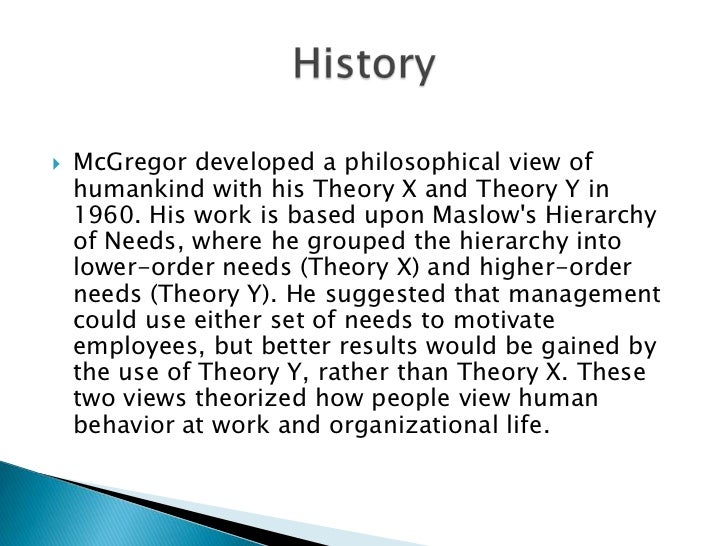
Theory X and Theory Y was an idea devised by Douglas McGregor (see article) in his 1960 book “The Human Side of Enterprise”. It encapsulated a fundamental distinction between management styles and has formed the basis for much subsequent writing on the subject. Theory X is an authoritarian style. Developed by many management theoreticians, among them Douglas McGregor, George. In 1961, Douglas McGregor published The Human Side of Enterprise. Another view of people that is not necessarily the opposite extreme of “X” was called. “Y” or theory Y. This set of assumptions about the nature of.
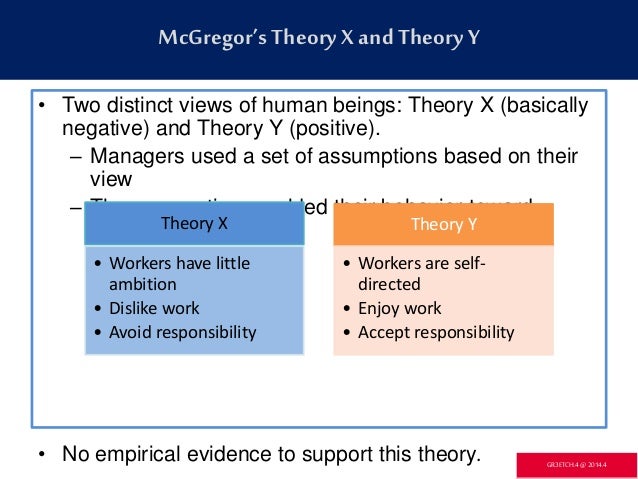
During the past 30 years, managers have been bombarded with two competing approaches to the problems of human administration and organization. The first, usually called the classical school of organization, emphasizes the need for well-established lines of authority, clearly defined jobs, and authority equal to responsibility. The second, often called the participative approach, focuses on the desirability of involving organization members in decision making so that they will be more highly motivated. Douglas McGregor, through his well-known “Theory X and Theory Y,” drew a distinction between the assumptions about human motivation which underlie these two approaches, to this effect: • Theory X assumes that people dislike work and must be coerced, controlled, and directed toward organizational goals. Furthermore, most people prefer to be treated this way, so they can avoid responsibility. • Theory Y—the integration of goals—emphasizes the average person’s intrinsic interest in his work, his desire to be self-directing and to seek responsibility, and his capacity to be creative in solving business problems. It is McGregor’s conclusion, of course, that the latter approach to organization is the more desirable one for managers to follow.
1 McGregor’s position causes confusion for the managers who try to choose between these two conflicting approaches. The classical organizational approach that McGregor associated with Theory X does work well in some situations, although, as McGregor himself pointed out, there are also some situations where it does not work effectively. At the same time, the approach based on Theory Y, while it has produced good results in some situations, does not always do so. That is, each approach is effective in some cases but not in others. How can managers resolve the confusion? A New Approach Recent work by a number of students of management and organization may help to answer such questions.
2 These studies indicate that there is not one best organizational approach; rather, the best approach depends on the nature of the work to be done. Enterprises with highly predictable tasks perform better with organizations characterized by the highly formalized procedures and management hierarchies of the classical approach. With highly uncertain tasks that require more extensive problem solving, on the other hand, organizations that are less formalized and emphasize self-control and member participation in decision making are more effective.
In essence, according to these newer studies, managers must design and develop organizations so that the organizational characteristics fit the nature of the task to be done. While the conclusions of this newer approach will make sense to most experienced managers and can alleviate much of the confusion about which approach to choose, there are still two important questions unanswered: 1. How does the more formalized and controlling organization affect the motivation of organization members? Netterm 5 4 6 1 Keygen Free. (McGregor’s most telling criticism of the classical approach was that it did not unleash the potential in an enterprise’s human resources.) 2.